Belle Haven's Discount Reflects Housing Stock and a Paused Development
Pull up the same Belle Haven address on three different valuation tools this month and you will get three different stories about the market. One shows prices falling by nearly ten percent over the past year. Another shows them rising by nearly six. A third lands somewhere in between. None of the three is wrong exactly. They are measuring a market so thin that a handful of closings can swing the average in either direction, and that thinness is the first thing anyone underwriting a Belle Haven purchase needs to understand before they touch the sale price.
But the volatility in the numbers is only half the story. The other half is what that $1.2 million to $1.3 million median has actually been pricing in, and why the thing it was pricing in just went quiet.
Menlo Park's citywide median sale price has hovered near $3.3 million through the first half of 2026. Belle Haven, the sub-market east of Highway 101 bordering Meta's headquarters, sits well below that. How far below depends entirely on which source you ask.
| Source | Figure | Window |
|---|---|---|
| Neighborhood sale-price data | $1,236,540 median, down 9.91% | April 2026 |
| Home value index (all homes, estimated) | $1,282,530, up 5.7% | trailing 12 months to mid-2026 |
| Market analytics estimate | $1,305,062 median | early 2026 |
| Trailing sale data | $1,227,500 median, down 8% | trailing 12 months |
Four sources, different figures and mixed year-over-year trends, all describing the same small neighborhood. That is not a data error. It is what happens when a neighborhood closes as few as a handful of sales in a given month. A single high-end remodel or a single distressed sale can move a median by tens of thousands of dollars, and different platforms weight their samples differently, update on different cycles, and blend estimated values with actual closings in different proportions. Days on market tell a more consistent story: Belle Haven properties have been taking roughly 25 days to sell, close to double the pace of tighter Menlo Park sub-markets, which reflects a buyer pool that is more mixed and a housing stock that is more heterogeneous than the citywide average suggests.
The practical consequence for anyone comparing neighborhoods off a portal screen: treat any single Belle Haven appreciation number with real skepticism. Ask your agent for the actual closed comps in the immediate blocks you are considering, not the neighborhood-wide average, because the average is doing more statistical work than the sample size can support.
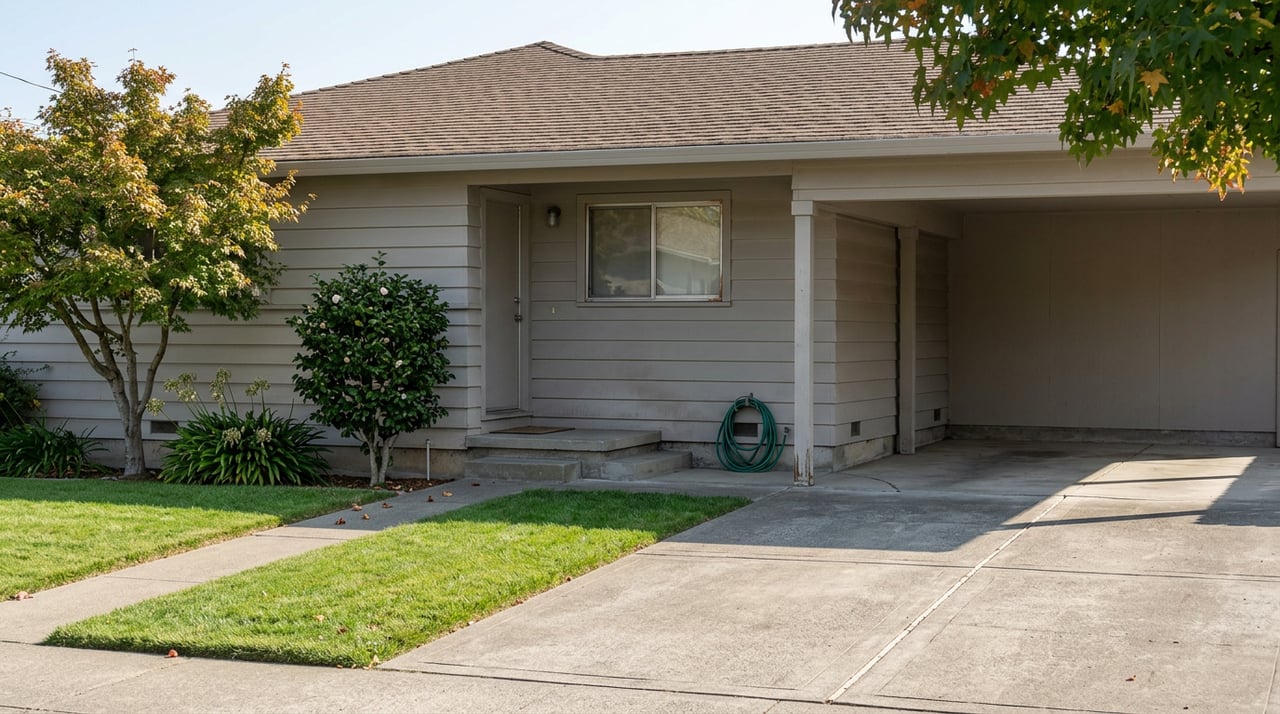
Underneath the noisy numbers sits a real story about why Belle Haven has traded at a discount to the rest of Menlo Park for years, and it is not only about home size and vintage, though those matter. Much of the housing stock here was built between the 1950s and 1970s and runs under 1,500 square feet. That alone explains part of the gap.
The other part of the story is Willow Village. In December 2022, the Menlo Park City Council approved Meta's plan to redevelop 59 acres of the former Menlo Science and Technology Park, the industrial site along Willow Road, Hamilton Avenue, and Hamilton Court that had sat mostly vacant for years. The approved plan called for 1.6 million square feet of office space, up to 1,730 housing units including 312 below-market-rate apartments, up to 200,000 square feet of retail including a full-service grocery store and pharmacy, a hotel, and roughly seven acres of new public open space including a town square and a dog park. Meta's development partner negotiated a package valued at approximately $188 million in community amenities, and the city projected around $6 million in new tax revenue once the project was built out.
For a neighborhood that longtime resident Peter Adams has described as lacking a pharmacy, a bank, or a post office, with residents relying on one gas station, a couple of small restaurants, and two bodegas, that amenity plan was not a nice-to-have. It was the thing that was supposed to close the amenity gap between Belle Haven and the rest of Menlo Park, and it is reasonable to think that expectation was baked into how buyers, investors, and content written about the neighborhood have talked about its upside for the past three years.
On May 1, 2026, Meta announced it was placing Willow Village on hold. The company's spokesperson attributed the decision to shifting real estate market conditions and an evolution in space requirements, saying the current environment did not support advancing a project of this type and scale. The pause landed in the same stretch of 2026 in which Meta disclosed plans to cut roughly ten percent of its global workforce, with Bay Area layoffs already surfacing in state WARN filings.
The development agreement between Meta and the city technically remains in effect until 2032. But the agreement itself is explicit that nothing in it obligates the developer to actually build. At a May 18, 2026 Planning Commission review, commissioners unanimously found Meta in good-faith compliance with the agreement's terms, largely because most of its obligations are conditioned on construction actually starting, and construction has not started. One commissioner put the underlying tension plainly during that meeting, warning that the city's state-mandated housing plan had assumed Willow Village's units would materialize and that the city could no longer count on a project moving forward simply because a private company had once agreed to it on paper.
Dashi, a Japanese restaurant that had operated in Belle Haven for 26 years, closed after receiving a 60-day lease-termination notice from a Meta-affiliated landlord. The restaurant had depended in part on foot traffic from workers at the surrounding tech park, and that traffic had already been thinning.
Not everything tied to Belle Haven's infrastructure is on hold. Willow Road itself, identified in the city's Vision Zero Action Plan as one of Menlo Park's highest collision corridors, is moving through design for a pedestrian and cyclist safety overhaul. At its July 14, 2026 meeting, the City Council directed staff to keep pursuing elevated and protected bike lanes along Willow Road, a pedestrian refuge island at Ivy Drive, and new crosswalks at O'Brien Drive and Bay Road, pulling $1.7 million from the city's Bayfront Mitigation Fund to keep the project eligible for state grant matching. The full design still needs state approval before the San Mateo County Transportation Authority can take over, a process the city's senior transportation engineer estimated would take another 15 to 18 months. Residents organized through Belle Haven Action have been pushing for these upgrades since 2018, and the project is advancing independent of whatever happens on the Willow Village site next door.
That distinction matters for anyone evaluating the neighborhood today. The safety improvements are a public commitment moving through a public process with a public funding source. By contrast, the grocery store and pharmacy were included in the development plan, but construction has not started.
A few things worth pricing in explicitly rather than assuming away:
None of this means Belle Haven is a bad place to buy. It means the discount reflects two different things layered together, housing stock and a paused development plan, and only one of those two is a fact about the property itself.
Is Willow Village dead? No. Meta describes it as paused, not canceled, and the development agreement with the city remains legally valid until 2032. But nothing in that agreement compels Meta to break ground on any timeline.
Does the pause affect current Belle Haven listings today? Not directly on title or zoning, but it removes a near-term catalyst that was part of the optimistic case for the neighborhood, and buyers should ask their agent to separate that expectation from the property's current, standalone fundamentals.
Is anything happening in the neighborhood right now? Yes. The Willow Road pedestrian and bike safety project is in active design as of mid-2026, funded in part through the city's Bayfront Mitigation Fund, independent of the Willow Village site's status.
Belle Haven's numbers deserve more scrutiny than a headline median gives them, and that is exactly the kind of due diligence Luxuriant Realty brings to every Silicon Valley transaction, reading past the portal figure to what is actually moving and what is actually stalled. Elevate Your Lifestyle. Request a Personalized Consultation.
This article is general information, not legal, tax or financial advice. Consult a qualified professional about your situation.
Experience the pinnacle of real estate excellence with Luxuriant Realty. Their dedicated team ensures a seamless and stress-free journey whether you're buying, selling, or managing properties, allowing you to elevate your lifestyle effortlessly.

LUXURIANT REALTY
885 OAK GROVE AVE, STE 302, MENLO PARK, CA 94025 CA DRE# 02190360 | NMLS# 2464074