Property Management in Menlo Park: Risks Every Owner Should Know
Owning a rental property in Menlo Park is unlike owning one almost anywhere else in the country. The same forces that make this one of the most desirable submarkets in Silicon Valley—proximity to Meta, top-tier school districts, a perpetually undersupplied housing stock—also make it one of the most demanding to operate. Rents routinely climb past $8,000 a month, tenant expectations run high, and the regulatory environment layers strict California state law on top of some of the more aggressive local tenant protections on the Peninsula.
After years of working with owners across Menlo Park, Palo Alto, and the surrounding communities, I've watched well-intentioned landlords stumble into five-figure mistakes over paperwork they didn't know they needed. This guide is meant to give you a clear-eyed picture of what it actually takes to own and manage a rental here—the market, the law, the costs, and the local realities that don't show up in generic advice.
Menlo Park remains a landlord-favorable market, but the headline number depends heavily on what you own and where it sits. A studio rents in the range of $2,350 to $3,125, while one-bedroom apartments command roughly $3,600 to $3,800 and two-bedrooms run from about $4,970 to $5,180. The real spread shows up in single-family homes, which range anywhere from $7,647 to over $14,000 a month—luxury properties in West Menlo and Sharon Heights pull the top of that range, while smaller homes in Belle Haven sit well below it. Condos, regardless of size, tend to cluster around $3,350.
What makes the market so favorable to owners is scarcity. The rental vacancy rate sits somewhere between 2.8% and 4.5% depending on asset class, with single-family homes near 2.5%—a structurally undersupplied segment. Premium properties in strong school districts often rent in under a week, while the typical listing clears in 14 to 18 days. Luxury single-family homes can take up to 25 days to land the right corporate tenant.
Rents have grown steadily after a brief cooling in late 2024, with apartments up 4.7% to 5.2% year over year. The strongest pressure has been on smaller units, where studios and one-beds have climbed as much as 6%, while some mid-tier two-bedroom Class A buildings have softened slightly and begun offering concessions like a free month of rent to compete for high earners. The deeper trend underneath all of this is that inventory has shrunk over the past three years—fewer owners are selling or moving, tenants are staying put longer, and that keeps upward pressure on any listing that does hit the market.
This is the section I'd ask you to read twice. The single most common way owners lose money in Menlo Park isn't a bad tenant or a deferred repair—it's a procedural misstep with the law.
California's Tenant Protection Act (AB 1482) caps annual rent increases on covered properties at 5% plus regional CPI, with a hard ceiling of 10%. For San Mateo County right now, CPI sits at 1.3%, which means the maximum allowable increase on a covered Menlo Park property is 6.3%.
The cap doesn't apply to housing built within the last 15 years (a rolling window), to duplexes where the owner occupied one unit at the start of the tenancy, or to single-family homes and condos—provided they aren't owned by a REIT or corporate entity and the landlord gave the tenant explicit written notice of the exemption.
That last point is where owners get burned. The single-family exemption is not automatic. To claim it, you must have included specific legal disclosure language directly in the signed lease. If that language is missing, your single-family home is legally treated like a regulated corporate apartment complex, and your annual increases are capped at the local CPI minimum. I've seen owners discover this only after trying to raise rent—at which point it's too late.
Once a tenant has lived in a unit for 12 months (or 24 if a new adult was added to the lease), you can't end the tenancy arbitrarily. Evictions must fall under "at-fault" just cause—nonpayment, a material lease breach, nuisance, illegal activity, requiring a 3-day notice to cure or quit—or "no-fault" just cause, such as an owner move-in, withdrawing the property from the market, or a substantial permitted remodel.
Here is the Menlo Park–specific detail that trips up independent owners constantly. Standard AB 1482 requires one month's rent in relocation assistance for a no-fault eviction. But the Menlo Park Tenant Relocation Assistance Ordinance requires up to 3 to 4 months' rent for qualifying low-to-moderate-income tenants. If you serve a standard California boilerplate eviction notice without accounting for the local ordinance—and fail to pay the relocation funds within 15 days—the entire eviction notice becomes void, and you start over from scratch.
A related pitfall is the "substantial remodel" eviction. Local tenant attorneys—Community Legal Services of East Palo Alto chief among them—scrutinize these aggressively. If your remodel doesn't actually require structural permits, or you fail to secure permits before serving notice, the eviction can be deemed fraudulent, exposing you to wrongful eviction and harassment claims.
California law now caps security deposits at one month's rent, whether the unit is furnished or unfurnished. There's a narrow exception: a natural person (or an LLC owned entirely by natural persons) who owns no more than two residential properties totaling no more than four units may charge up to two months—but that exception evaporates if the tenant is a military service member, in which case the one-month cap applies.
Then there's the 21-day rule. Under Civil Code 1950.5, you have exactly 21 calendar days after move-out to return the deposit with an itemized statement and receipts for any deductions. In a market with a chronic skilled-labor shortage, finding licensed contractors to complete turnover repairs inside that window is genuinely hard—and missing the deadline or relying on unitemized estimates lets a tenant sue for bad-faith retention, which carries statutory penalties of up to twice the deposit amount plus damages.
The timelines are rigid. You need 24 hours' written notice to enter for repairs, inspections, or showings (48 hours for a move-out inspection). Rent increases require 30 days' notice if the cumulative increase over 12 months is 10% or less, and 90 days if greater (relevant only to exempt properties). Terminations require 30 days' notice for tenancies under a year and 60 days for those of a year or longer.
With almost no exceptions, anyone renting residential property inside Menlo Park city limits is considered to be operating a business and must hold a valid City Business License, taxed on gross receipts or employee count. If you're renting for fewer than 30 consecutive days, you also need a Transient Occupancy Tax account; the local TOT rate is 15.5% of gross rental revenue, and Airbnb and Vrbo do not collect it for you—you remit it manually each month. Note too that units built under SB 9 urban lot splits are banned from short-term rental use entirely.
Because Menlo Park rents are so high, even ordinary percentage-based fees carry real weight. Most full-service managers charge 8% to 12% of monthly collected rent for single-family homes and 6% to 8% for multi-family. On a home renting at $8,000 a month, an 8% fee is $640 per month, or $7,680 a year, just for day-to-day oversight. Newer tech-forward platforms offer flat fees of roughly $150 to $300 a month regardless of rent.
The line items that surprise owners are the ones buried in the contract: maintenance markups (often an extra 10% on a contractor's invoice), lease renewal fees ($150 to $300, or up to 25% of a month's rent, simply to re-sign an existing tenant), and vacancy fees of $50 to $150 a month to monitor an empty property. Read every contract for these before signing.
If you'd rather handle the day-to-day yourself and only want a professional to place the tenant, expect a one-time leasing fee of 50% to 100% of the first month's rent. On a $10,000 luxury rental, a 50% placement fee is a $5,000 check. For that, a competent Peninsula firm should deliver professional HDR photography, 3D tours, syndication across Zillow, Trulia, and the MLS, accompanied showings, rigorous screening, and a CAR-compliant lease.
One more compliance point that protects you directly: in California, managing property for others for compensation requires an active Real Estate Broker's license under Business & Professions Code 10130–10131(b). A salesperson can't run an independent management company. And all rents and deposits must flow into a designated broker trust account within three business days, reconciled monthly and subject to DRE audit. If a manager can't speak fluently to any of this, that's a meaningful warning sign.
California's property tax structure rewards long holds and punishes the moment of purchase. Under Proposition 13, your base rate is 1% of assessed value plus voter-approved bonds—an effective rate of roughly 1.1% to 1.25% in San Mateo County—with assessed value rising no more than 2% a year. Hold long enough and your tax basis falls far below market value.
The catch is reassessment. The moment an investment property changes hands, it's reassessed at current market value. Buy a Menlo Park home for $3.5 million and your initial tax bill lands around $38,500 to $43,750 a year, regardless of what the prior owner paid. Older West Menlo neighborhoods rarely carry Mello-Roos, but newer developments sometimes do—always check the parcel's preliminary title report.
The upside: unlike a primary residence, which faces the $10,000 SALT cap, an income property lets you fully deduct property taxes, management fees, maintenance, and depreciation against rental income on Schedule E.
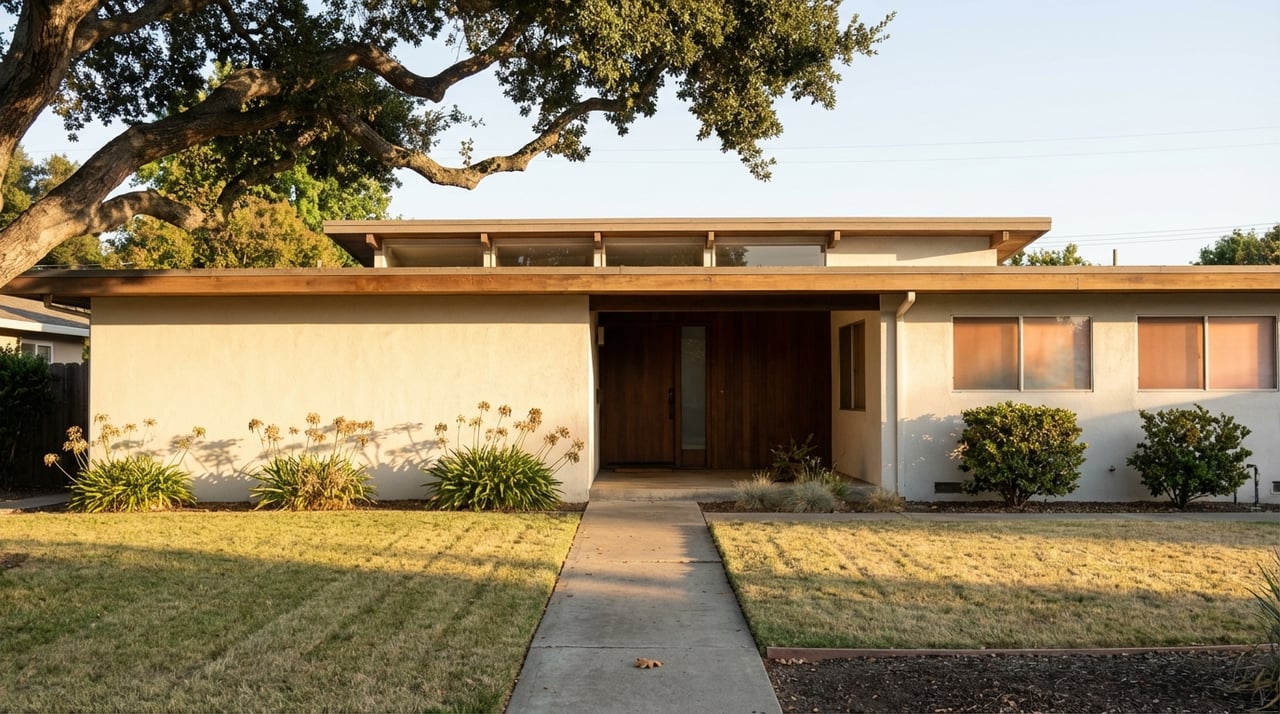
The physical profile of your property shapes everything about operating it. West of El Camino—Sharon Heights, West Menlo—single-family homes and low-rise condos from the 1950s through 1970s often carry original cast-iron plumbing prone to root intrusion, outdated 60–100 amp electrical panels that can't support an EV charger without a $5,000–$10,000 upgrade, and frequently no central air, which premium tech tenants increasingly expect.
East of 101 and in central pockets like The Willows, you'll find a mix of 1940s–50s bungalows—often dealing with foundation settling in expansive clay soil—alongside a wave of new transit-oriented luxury complexes like Anton Menlo, Springline, and Lume. The new Class A stock has minimal structural needs but heavy corporate overhead and complex fire-suppression and parking systems.
Rents vary sharply by neighborhood, driven largely by school district lines (Menlo Park City School District versus Ravenswood) and proximity to Caltrain. Here's how two-bedroom apartment rents break down:
Neighborhood | Profile | Avg. 2-BR Rent |
|---|---|---|
Sharon Heights | Hilly, affluent, near Stanford & I-280 | $5,400–$6,700 |
Linfield Oaks / Allied Arts | Highly walkable, adjacent to downtown | $4,300–$4,650 |
Downtown Menlo Park | Centered on Santa Cruz Ave, transit-rich | $4,100–$4,500 |
The Willows | Family-centric, mostly single-family | $4,300–$5,200 |
Belle Haven | Older affordable stock + new luxury builds | $3,360–$3,750 (older) / $4,800+ (new) |
Budget for the "Silicon Valley premium" on every repair. Contractors quietly build a markup into 94025 bids to cover parking, noise rules, and compliance overhead. Handyman work runs $95–$150 an hour with a $150–$200 minimum trip fee. Licensed electricians and plumbers run $175–$275+ an hour; snaking a main sewer line averages $350–$600. HVAC techs charge $150–$250 an hour, and dropping central AC into a mid-century home with duct work can run $14,000–$22,000. A turnover deep clean on a two-bedroom runs $350–$600, and repainting a 1,500-square-foot home starts at $4,500–$7,000.
Menlo Park is one of the most rewarding rental markets in the country to own in—and one of the least forgiving to operate carelessly. The difference between a smooth, profitable tenancy and a costly legal entanglement usually comes down to the details: the disclosure language in your lease, the relocation calculation on a no-fault notice, the 21-day clock on a deposit. None of it is impossible to manage. But it does demand local knowledge and discipline.
Considering professional management or have questions about your Menlo Park property?
I'm Tim Proschold, CEO and Managing Broker at Luxuriant Realty in Menlo Park. I'm a licensed California Real Estate Broker (#01458118) and a licensed California Civil Engineer. Before real estate, I spent years in structural design and construction management across the public and private sectors—which means when I walk a property, I tend to catch the things others miss: the aging electrical panel, the foundation movement in clay soil, the plumbing that's about to become a problem. For owners on the Peninsula, that engineering perspective often translates directly into avoided surprises and smarter long-term decisions.
If you'd like to talk through your property, your options, or simply get a straight answer to a question, I'm happy to be a resource.
Tim Proschold — CEO & Managing Broker, REALTOR® Luxuriant Realty | 885 Oak Grove Ave, Ste 302, Menlo Park, CA 94025 [email protected] | (650) 200-5943
This guide is for informational purposes and reflects general market and regulatory conditions; it isn't legal or tax advice. Laws and local ordinances change, so confirm specifics with a qualified attorney or tax professional before acting.
Experience the pinnacle of real estate excellence with Luxuriant Realty. Their dedicated team ensures a seamless and stress-free journey whether you're buying, selling, or managing properties, allowing you to elevate your lifestyle effortlessly.

LUXURIANT REALTY
885 OAK GROVE AVE, STE 302, MENLO PARK, CA 94025 CA DRE# 02190360 | NMLS# 2464074