Planning a remodel or new build in Menlo Park and not sure how big you can go or where you can place it on the lot? You are not alone. Between floor-area ratio, lot coverage, and setbacks, it can feel like a puzzle. This guide breaks down each rule in plain language, shows how they work together on real projects, and outlines smart steps to move from idea to permit with fewer surprises. Let’s dive in.
What FAR, lot coverage, and setbacks mean
Floor-area ratio (FAR)
FAR compares your total building floor area to your lot size. It controls overall size and massing. Both stories of a two-story home count toward FAR, not just the footprint. FAR is about total square footage, not how much ground the home covers.
Lot coverage explained
Lot coverage limits how much of the lot your building footprint can cover. This focuses on ground-level coverage and open space. It affects drainage and yard space, so a single-story design can hit coverage limits even if FAR is still available.
Setbacks basics
Setbacks are the minimum distances between your building and the front, side, and rear property lines. They shape where you can place additions, garages, and decks. Certain projections like eaves or porches can sometimes encroach by limited amounts, and separate rules may apply to elements like fences or retaining walls.
Related controls
Height, number of stories, and plate heights work with FAR and setbacks to form a buildable envelope. Parking, required open space, impervious surface rules, and stormwater requirements can also influence layout and feasibility.
How Menlo Park applies these rules
Zoning is parcel-specific
In Menlo Park, FAR, lot coverage, setbacks, and height limits vary by zoning district and sometimes by lot size or subcategory. Do not assume your property matches a neighbor’s. The first step is to confirm your exact zoning designation.
Where to verify your standards
The Menlo Park Municipal Code includes definitions and numeric standards. The City’s Zoning Map and GIS viewer show your property’s district. Planning Division and Permit Center staff can confirm how the rules apply, explain any updates, and outline design review thresholds. Design guidelines may add expectations beyond raw numbers.
How the rules interact on real projects
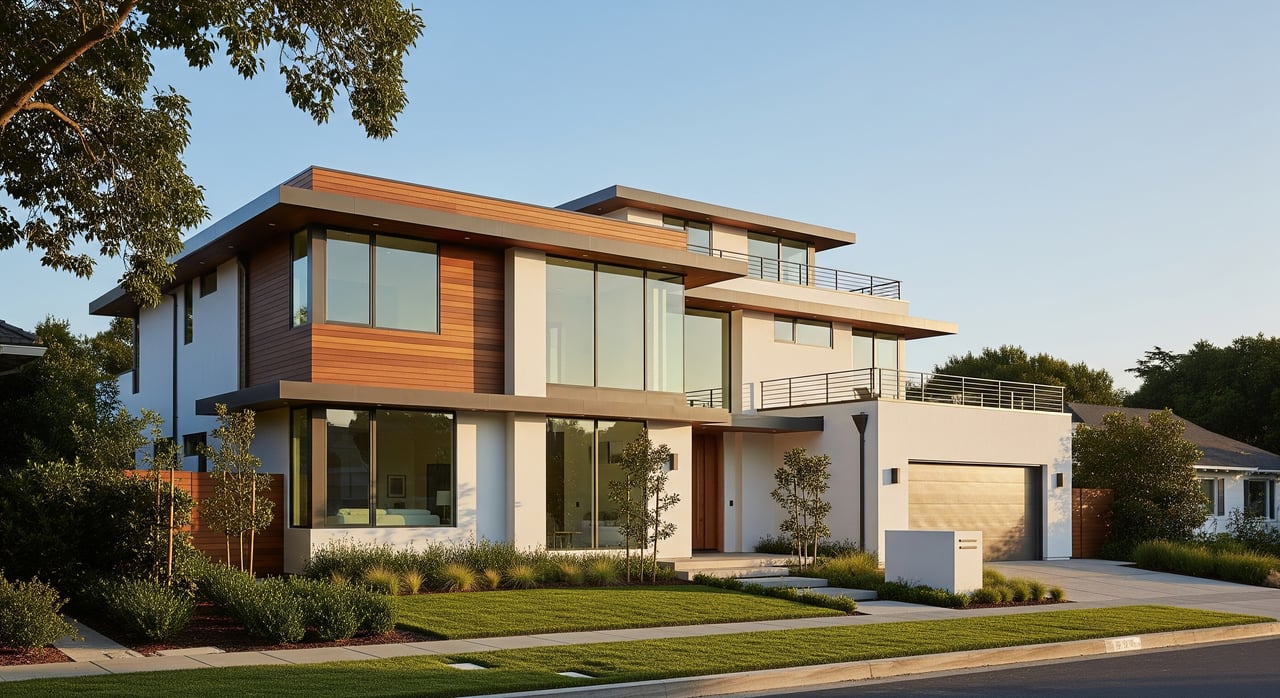
A ground-floor addition increases both footprint and total floor area, so it touches coverage and FAR. A second-story addition adds FAR without much footprint. Setbacks restrict where additions can sit. Even if FAR and coverage allow the size you want, setbacks may push you toward a narrower or taller design. Height limits and story limits can shape massing choices and reduce the floor area that fits under a roofline.
ADUs are a special case
California state law requires cities to allow Accessory Dwelling Units that meet objective standards, and some local rules treat ADU square footage differently for FAR and coverage. Menlo Park’s ADU ordinance and state guidance can change how ADUs count. Always confirm current ADU treatment before you finalize design.
How to calculate at a high level
Quick formulas
- FAR = total gross floor area of all levels divided by lot area.
- Lot coverage = building footprint area divided by lot area.
- Setbacks = minimum required distance from each property line to the structure.
Hypothetical walk-throughs
The examples below are for illustration only. Always confirm the actual standards for your parcel.
- Example A: Understanding FAR
- Hypothetical lot: 6,000 sq ft.
- If FAR were 0.5: allowable total floor area would be 3,000 sq ft. A two-story home could be about 1,500 sq ft per level.
- Example B: Lot coverage vs FAR
- Same lot with a hypothetical 30 percent coverage limit: footprint would be 1,800 sq ft. To reach 3,000 sq ft total, you would likely need a second story.
- Example C: Setbacks constrain placement
- Hypothetical front setback 20 ft, side 5 ft, rear 15 ft. Even if FAR and coverage allow the size, setbacks may require a taller, narrower design or a different addition location.
- Example D: ADU interaction
- If a local rule excluded a small ADU from FAR up to a threshold, you could add an ADU without using your primary FAR. Treatment varies, so verify Menlo Park’s current approach.
Process and timelines in Menlo Park
Typical steps
- Confirm your zoning and all numeric standards for FAR, lot coverage, setbacks, and height.
- Meet with Menlo Park Planning staff early, especially if your concept is close to limits.
- Measure existing conditions: lot lines, easements, protected trees, and any topography.
- Run preliminary FAR, coverage, and setback calculations with your architect.
- Prepare submittals for a building permit and, if needed, design review or a variance.
- Navigate plan check, respond to corrections, obtain permit, and start construction.
Expected timelines
- Ministerial permits that meet objective standards can move within weeks to a few months, depending on plan check cycles.
- Discretionary approvals or variances may take several months to a year or more, based on complexity, hearings, and revisions.
- Pre-application meetings should be booked in advance and often save time by catching issues early.
Common pitfalls to avoid
- Relying on neighborhood assumptions instead of your parcel’s exact zoning and standards.
- Missing floor area that counts toward FAR, such as certain covered or partially below-grade spaces, garages, or mezzanines.
- Miscounting lot coverage by overlooking covered decks, attached canopies, or other structures.
- Assuming ADUs are always exempt from FAR. Local ordinance details and state rules matter.
- Ignoring easements, floodplain constraints, or protected trees that reduce buildable area.
- Skipping early conversations with Planning or the building department. Late discoveries often force redesigns.
- Converting garages or basements without re-checking parking and FAR implications.
Early-planning checklist
- Confirm parcel zoning, lot size, and any overlays that affect design or review.
- Pull the latest lot area and existing building area from plans or assessor data.
- Schedule a pre-application or counter meeting with Menlo Park Planning and Building.
- Ask how ADUs are counted for FAR and coverage under current local rules.
- Map protected trees, utility easements, or other constraints on a site plan.
- Clarify whether your scope triggers design review or other discretionary approvals.
- Request an estimate of review timelines and typical plan check cycles for similar projects.
- Engage an architect or permit professional experienced with Menlo Park to validate early calculations.
When you might need exceptions
If your concept exceeds FAR or coverage or needs to encroach into setbacks, you may explore variances or other discretionary approvals. These require findings, public notice, and more time. Properties in historic districts or with landmark status may face additional standards. Early feedback from Planning and a design strategy that responds to the review criteria can improve outcomes.
Move forward with confidence
You do not need to be a code expert to plan a great project. You just need the right process and a team that understands the rules and the design trade-offs. With clear zoning confirmation, early meetings with Planning, and accurate FAR, coverage, and setback calculations, you can align your design with Menlo Park’s standards and avoid costly redesigns.
If you want a trusted local partner who pairs construction-informed insight with boutique service, our team is here to help you plan, buy, sell, or prepare a property for its next chapter. Connect with Luxuriant Realty to review options and map out next steps.
FAQs
What is FAR in Menlo Park?
- FAR compares total building floor area to lot size and is applied by zoning district, so you must confirm your parcel’s specific standards with the Municipal Code and Planning staff.
How do lot coverage and FAR differ?
- Lot coverage limits ground-level footprint while FAR limits total square footage across all stories, so a two-story design can meet coverage limits while using available FAR.
Do ADUs count toward FAR in Menlo Park?
- Treatment of ADU square footage varies under state law and local ordinance, so you should verify current Menlo Park ADU rules before finalizing design.
How do setbacks affect home additions?
- Setbacks define buildable areas and can push additions away from property lines, sometimes requiring a narrower footprint or additional story to meet size goals.
Who should I contact to confirm my standards?
- Start with the Menlo Park Planning Division and Permit Center, review the Municipal Code and Zoning Map, and consult an experienced local architect for parcel-specific calculations.